
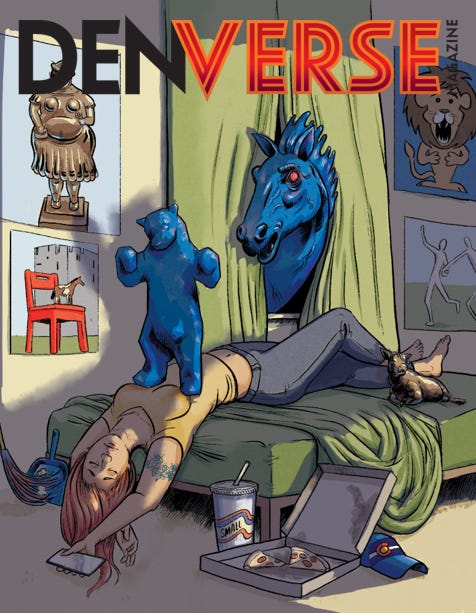
“Art through adversity” is one of our favorite mantras. If it’s easy, then it’s too easy. In this interview, the editor talks to Denver artist Cori Redford, the talent behind our fall issue cover, as we take you through the trials of creating original magazine art—an old-fashioned practice that we are proud to carry forward.
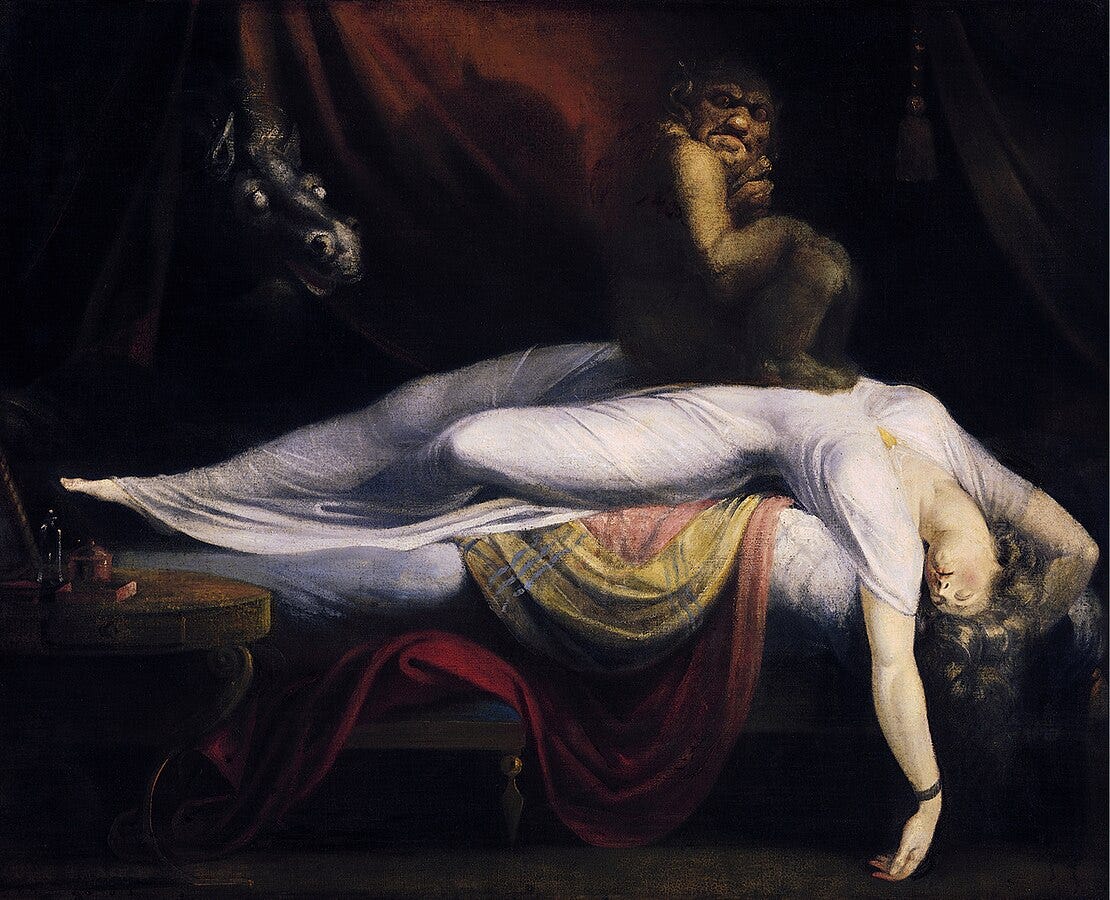
Denverse Magazine: So I had this kind of weird idea for a cover, you know. I like to keep things as playful as possible. And I was like, well, what if we took this classic painting, The Nightmare by Henry Fuseli, and just threw some Denver iconography in there?
So when I first pitched you on the idea, what did you think? What was your reaction to it? And how did you first approach the work itself?
Cori Redford: I thought it was a fun idea. And the first thing I did was look up all the versions of the original painting. Because there are actually several artists who have done it. And the original is in a horizontal format. So I looked to see how other artists had solved that same problem in a vertical format. And I did some sketches and thought about what kinds of things would be fun for me to draw, what I wanted to put in there, and what I thought was funny. I didn’t think of that many funny things, but that’s just a good starting place, generally.
And the pose was a little complex. So I found a poser online to arrange a body in that same position to get an idea of the anatomy.
DM: Wait, how does that work? Poser online?
CR: So it’s like an interactive 3D model of a person. And you can turn them in three dimensions and move their limbs. So you get the pose that you want. I mean, I probably could use, like, a mannequin. But the online version is a little more fluid.
DM: Oh, that’s super cool. Yeah, let me bring up the original version on my phone.
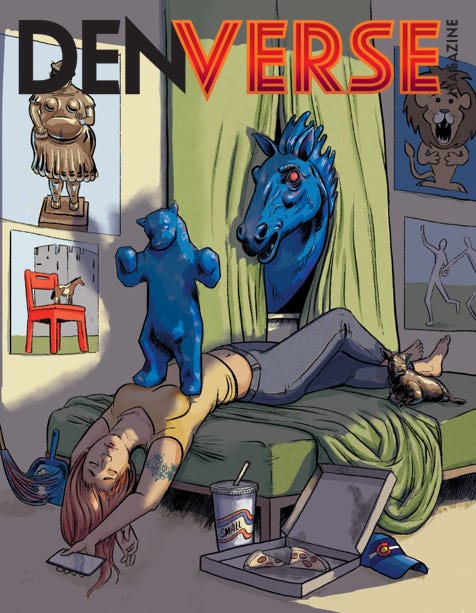
DM: So yeah, this is the original version. And so the initial idea was, like, it’s just a young woman living in Denver. We were going to recreate the Fuseli painting. And we had some Denver art iconography in there, other than the bear and Blucifer. But tell me about your other decisions with this piece.
CR: I actually took a picture of my own bed for each of the versions. My bedspread is a different color. But I tried to choose colors that unified the image. I knew that your logo was red. So I felt okay about only having a couple of spots of red, but I decided to spread the blue around and have the green sort of unite it in the vertical. And the walls are a very close neighbor to this green.
DM: Oh, that’s fascinating. I love that. It’s very fun for me, as someone with no artistic talent to hear about the process. And what was the decision to put the calf in there all about? Just like a little Easter egg thing?
CR: Yeah, I mean, I was thinking about a cat, and I love that calf that’s behind the Denver Art Museum. These are all pieces. This is the lion from outside of Lion’s Lair. And I’m sure you recognize the stuff from the Bellco, the DCPA, the Denver Public Library, the DAM. And then we just have some other random debris.
DM: Yeah, and now, it’s so funny. We talked about this over the phone, but I showed this version to about 10 people in my circle that I trusted. And about 30% of the people really liked it. They were like, oh, this is really cool. And then about 70% of the people were like… They used a certain word, which we won’t include in the interview. But you know the word that I’m going to say.
CR: Yep.
DM: And I must have had my blinders on. Because to me, I was just thinking of having fun and playing around with this original work. It was kind of stupid of me, actually.
CR: Well, I mean, that is a succubus in the original.
DM: I know, I know. I wasn’t even thinking about that. I was just like, oh, let’s have fun and riff off this. And the original painting was very controversial for its sexuality. So, of course, when I showed it to these other people, that was the same reaction they had. The power of the art hadn’t changed, even after centuries. That’s not what we were trying to do, but, of course, that is inherent in the original piece.
So what was your reaction upon hearing about that test group reception?
CR: I sort of thought that your intention was carried through from the original. And that the humor was in that the bear is so sexless. Although Blucifer is pretty threatening in any iteration.
DM: Haha. Right!
CR: But I think I assumed that you wanted something a little more risqué.
DM: I actually went back and forth on it for a bit. Because, at the same time, I was thinking, well, why not be a little bit provocative? Why not have fun with it and just do what we want? Because we did capture the spirit of the original painting. In fact, I had a few people, when I told them that we were going to soften things a little bit, who said, No, no, you shouldn’t do that. Just have fun with it. Do your thing. But at the same time, I had to think about risks. Do we want to just be provocative for provocation’s sake? For a publication like this, it’s delicate. It’s only our second issue. Nobody knows us. Nobody knows what our intentions are. And so for us to come out of the gate with something that…again, I want to avoid seeming like a provocateur. Because it’s cheap. It’s a cheap gesture. The whole purpose of this was to be fun. But I wasn’t trying to disturb anyone. So when you heard that feedback, guide us through the decision-making process, what you decided to do to revise the work.
CR: I think you had a pretty clear vision. But I think that maybe we had some misunderstanding about how this works, because I think that you were thinking of it like an animation where you can just repose the whole thing.
DM: Haha! I know, I was like, surely you can just easily change the whole thing, right?
CR: Yeah, no. There’s an ink layer, there’s a color layer, and there’s a shadow layer. So, to change something, you have to redraw it. And I had to pose that body. I had to repose and restart. Which, you know, I don’t mind the extra work. Because that’s more money for me. So I think we both learned something.
DM: We certainly did!
CR: But yeah, I don’t mind. I got to try a different thing. I actually had a stack of canvases on my floor, so that was very easy to just put by my bed and take a picture.
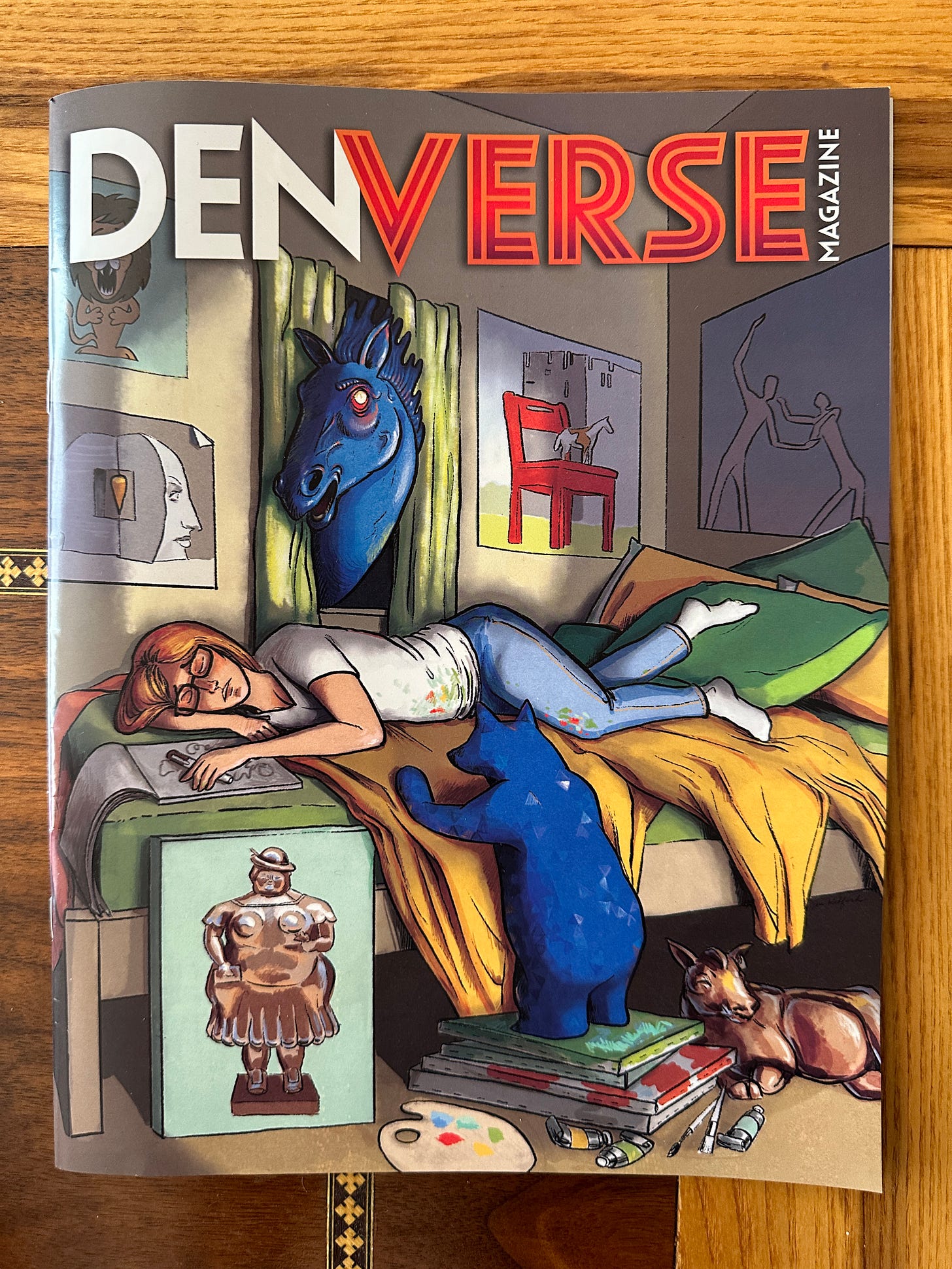
DM: Several people have commented on that. They love this detail, how the bear is standing on the canvases. And I think this is by far superior to the original version. Because the bear’s posture is, of course, an exact imitation of the real thing. And it’s kind of cute. You know, a constant mantra for me, in any creative endeavor is art through adversity. I always think that if something is easy in this business, it’s probably too easy. And for this to be produced through a very arduous process, which I don’t know if it was that arduous, but it was iterative at least, well, that actually gave me more faith in the work. It arrived as it was supposed to: with difficulty. And so we decided, hey, let’s change the concept a little bit. Because before it was just a young woman in Denver, kind of a central casting woman in Denver. But now let’s make her an artist. And let’s make it clear that she’s an artist, and that she’s haunted by these Denver icons. And that’s what Blucifer will be, et cetera.
And so you incorporated some other details here. Oh, tell me about the shading. These contrasts between the light and the darkness, the shadowing, it’s really cool in here. How do you do that?
CR: So, since I work digitally in Photoshop, I put a layer of a cool gray on top of it. And then I basically erased everything that I wanted to be light. And my concept was that her door… You know, she fell asleep by accident. She’s working or something. She left her hall light on. So the light is being cast from the hall. And that’s why it’s sort of cut off.
DM: Oh, that’s awesome. It’s a great piece. People really love it.
CR: Oh, thank you. Well, I do a lot of comics, so it was very much in my wheelhouse.
DM: Right. Well, when I was looking at your portfolio, I was like, you are just, like, the perfect person to work on something like this, because you have this great combination of underground zine work and professional experience, and that’s kind of like the sweet spot of what I’m hoping to accomplish with this publication. And, again, really great. A lot of people are responding positively to it. So, thank you again.
CR: My pleasure.

Paul M. French is the founder and editor of Denverse Magazine.